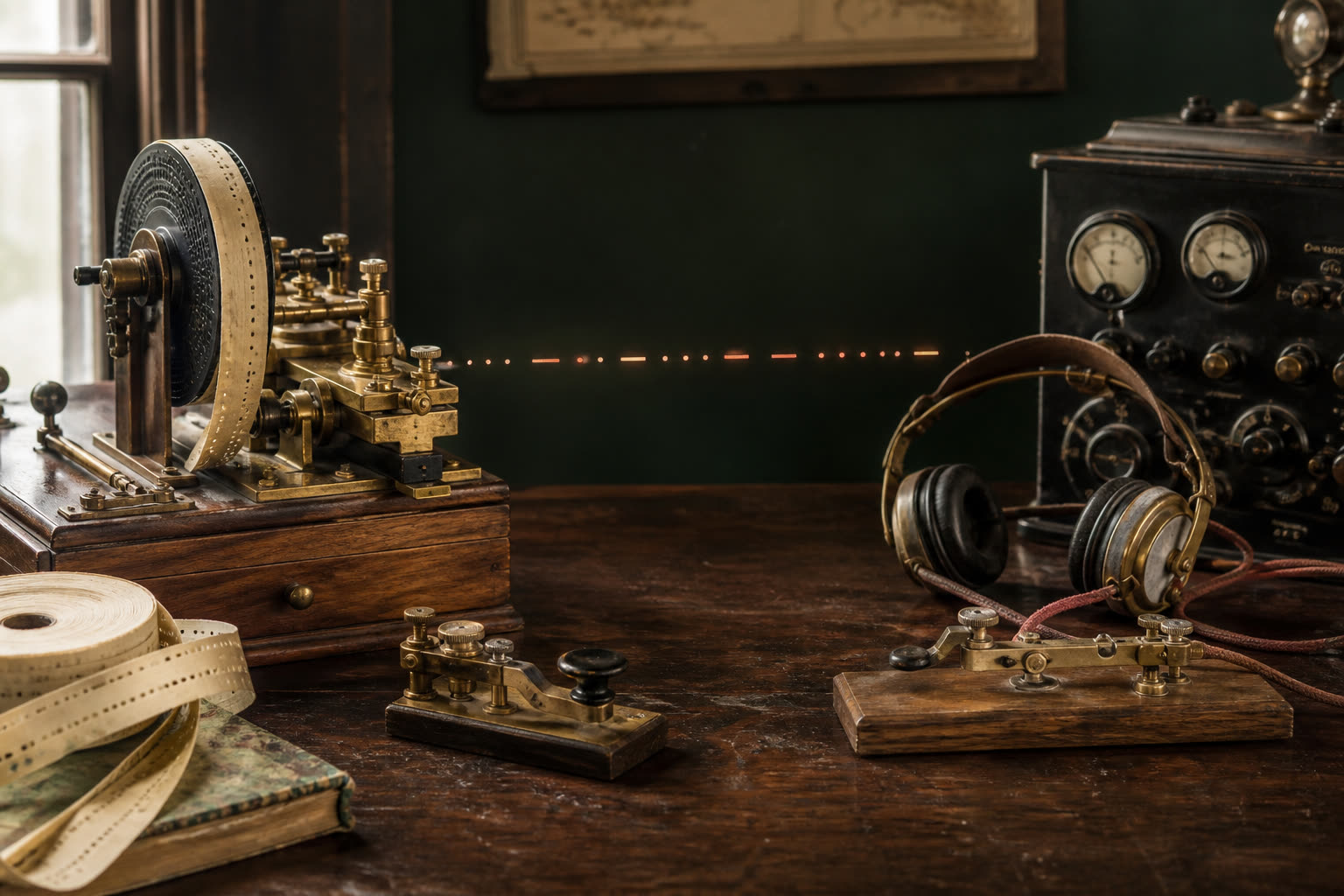
“Morse code” can refer to two related systems. American Morse grew around nineteenth-century landline telegraphy; International Morse became the common alphabet for radio and modern references.
The first system belonged to the wire
Samuel Morse, Alfred Vail, and their collaborators developed an electrical telegraph system in the 1830s and 1840s. Early receivers marked a moving paper tape. Operators soon learned to recognize the mechanism’s clicks directly and write the message without reading the tape.
The code used on North American landlines is now usually called American Morse or Railroad Morse. It includes short and long marks, but it also relies on timing distinctions inside some characters. That gives it a different cadence from the International alphabet familiar to radio operators.
International Morse simplified cross-border use
European telegraph networks adapted the system for their languages and operating conditions. The resulting alphabet was standardized internationally and later became closely associated with wireless telegraphy. Today, ITU Recommendation M.1677 defines the International Morse signals and their spacing.
The two systems share the core idea and several patterns, but they are not interchangeable character for character. A message sent in one system can produce wrong letters when a listener assumes the other.
Why modern translators use International Morse
International Morse is the useful default for amateur radio, signal lamps, training software, reference charts, and most online translators. Its dot–dash patterns and 1–3–7 timing model are documented in a current international recommendation. Unless a tool explicitly offers American Morse, entering a historical landline message may produce misleading output.
How to recognize the context
- A modern radio, learning app, signal lamp guide, or maritime reference almost certainly means International Morse.
- A nineteenth-century U.S. telegraph manuscript, railroad record, or sounder demonstration may use American Morse.
- A printed chart should name its alphabet. If it does not, compare several letters before trusting it.
Morse was a system, not one isolated invention
The telegraph combined electrical research, relays, wire networks, sending keys, receivers, operating procedures, and trained people. The Library of Congress records how Morse’s work depended on collaborators such as Leonard Gale, Joseph Henry’s relay research, Alfred Vail’s technical work, and Ezra Cornell’s construction expertise.
That history explains why the code changed. A practical signaling system evolves with its medium. Landline sounders, submarine cables, radio transmitters, lamps, and software do not impose exactly the same needs—even when they all use short and long signals.
MorseDock’s chart, translator, audio, and practice tools use International Morse code.