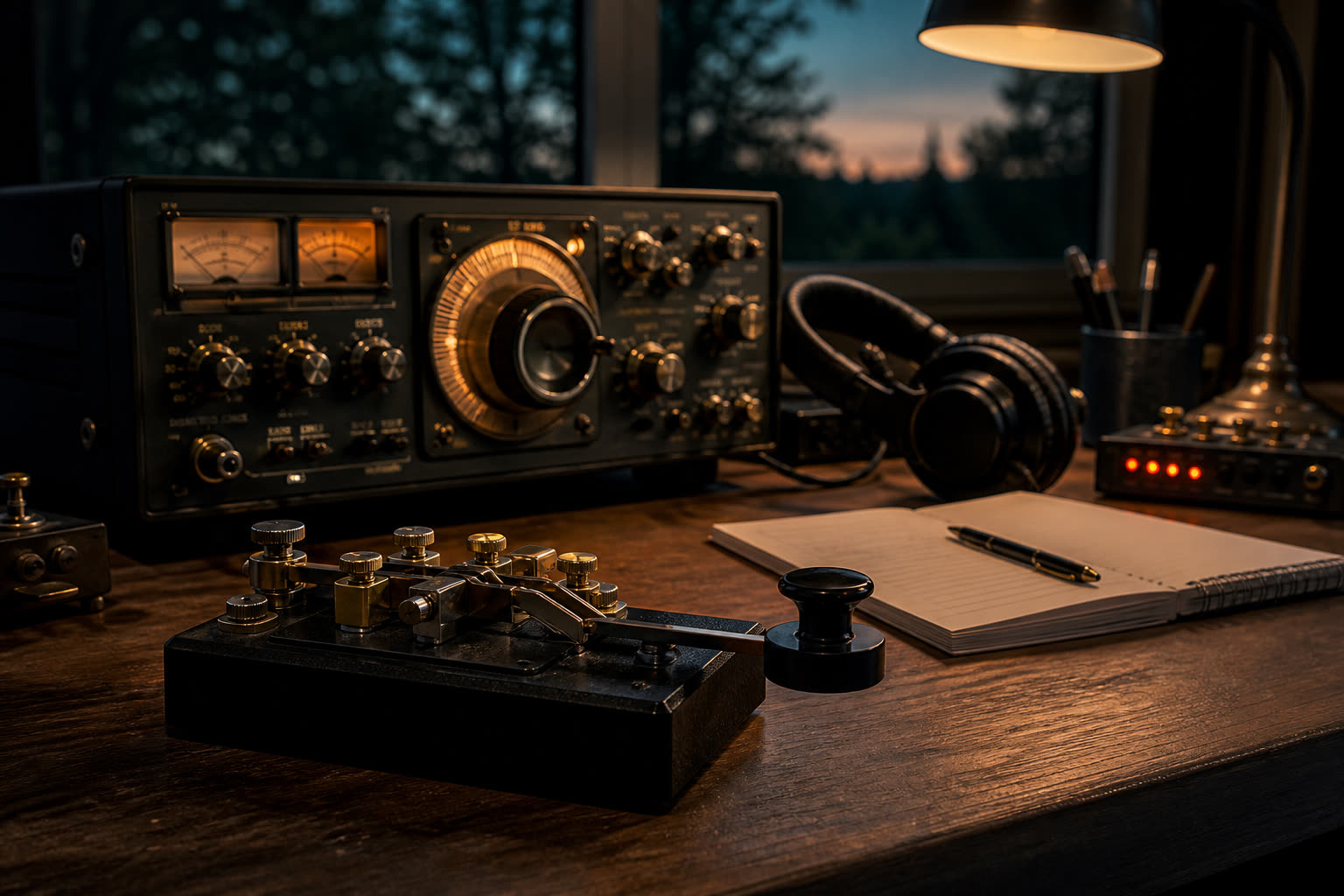
On amateur radio, Morse transmission is usually called CW. A basic contact is short, structured, and easier to follow when both operators know what information comes next.
What CW means
CW stands for continuous wave. The transmitter produces a carrier, and the operator switches it on and off with a key or electronic keyer. A receiver turns those keyed bursts into an audible tone. The information is carried by the timing of the signal, not by a voice modulating it.
A CQ call invites a reply
CQ is a general call. An operator sends CQ, identifies the station, and finishes with a signal that hands the frequency to a possible respondent. A simplified pattern looks like this:
CQ CQ CQ DE [CALL] [CALL] KDE means “from,” and K invites another station to transmit. Real callsigns and procedures are governed by the operator’s licensing authority, so a translator exercise is not permission to transmit on amateur frequencies.
The reply establishes who is present
A responding station sends the called station’s callsign, DE, its own callsign, and K. Once both identities are clear, the contact can move to a signal report and basic information. Repeating critical information is normal when conditions are weak, but excessive repetition occupies the frequency without adding clarity.
Common information in a first contact
- RST: readability, signal strength, and tone report.
- QTH: station location.
- NAME: the operator’s name, often sent in a predictable group.
- RIG and ANT: equipment and antenna, when the operators want a longer conversation.
- WX: local weather.
Abbreviations reduce transmission time, but they work only when both people understand them. QSL acknowledges receipt, QRS asks for slower sending, and AGN asks for a repeat. Sending plain language is better than forcing obscure shorthand into every sentence.
Closing the contact
73 is a customary friendly closing. The prosign AR marks the end of a message, while SK marks the end of contact. Prosigns are sent as joined patterns rather than as two normally spaced letters.
Good operating begins with listening
- Listen before transmitting and make sure the frequency is not in use.
- Match the other operator’s speed when possible.
- Send complete character rhythms with clean gaps.
- Ask for a repeat instead of guessing important information.
- Follow the identification, band, power, and operating rules that apply in your country.
You can rehearse common signals in the abbreviations and Q-code reference, then build recognition with the listening trainer.