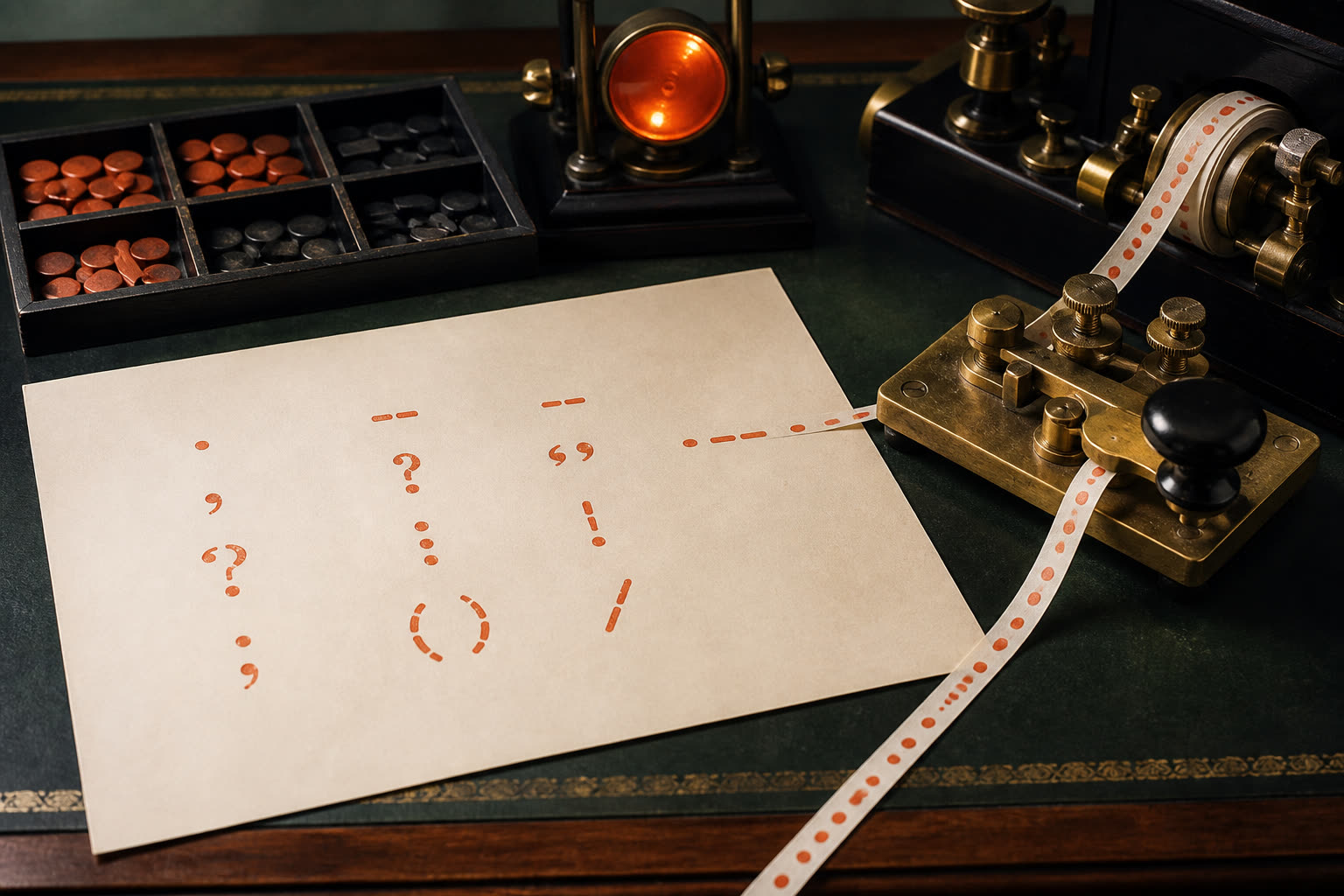
Punctuation belongs to the written message. Prosigns belong to the procedure of sending it. They may look similar on a chart, but their spacing tells the operator which job they perform.
Punctuation encodes a printed character
A period, comma, question mark, slash, and at sign each have an International Morse pattern. They are transmitted as individual characters with normal gaps before and after them. Useful examples include:
- Period
.-.-.- - Comma
--..-- - Question mark
..--.. - Slash
-..-. - At sign
.--.-.
Punctuation can improve clarity, but it is longer than most letters. Operators often shorten informal traffic rather than reproducing every mark from ordinary prose.
A prosign controls the exchange
A procedural signal combines letter-like elements into one uninterrupted character. The usual notation places the letters together or inside angle brackets, but the transmitted pattern has no ordinary letter gap in the middle.
.-.-.end of message·BT
-...-separator·SK
...-.-end of contact
If AR were sent as ordinary letters, it would contain a three-unit letter gap between .- and .-.. The joined prosign keeps only the one-unit gaps between its five signal elements. That timing difference is the definition.
SOS is a joined distress signal
SOS is commonly printed with three familiar letters, but the distress signal is sent continuously as ...---.... It is distinctive because of its rhythm, not because it expands to a phrase. Official maritime rules list it among several internationally recognized distress signals.
Written notation varies
Books, logs, and software may write a prosign as <AR>, place a bar over the letters, or show only the joined dot–dash pattern. The typography is secondary. What matters on the air is whether the elements are sent as one character.
Choose the signal that matches the task
- Use punctuation when the receiving person needs the mark as part of the text.
- Use a prosign when controlling the flow of a transmission.
- Do not invent a prosign by removing the gap between arbitrary letters.
- Do not use SOS for practice where it could be mistaken for a real distress call.
The Morse code chart keeps punctuation and prosigns in separate sections so their roles and joined forms remain clear.