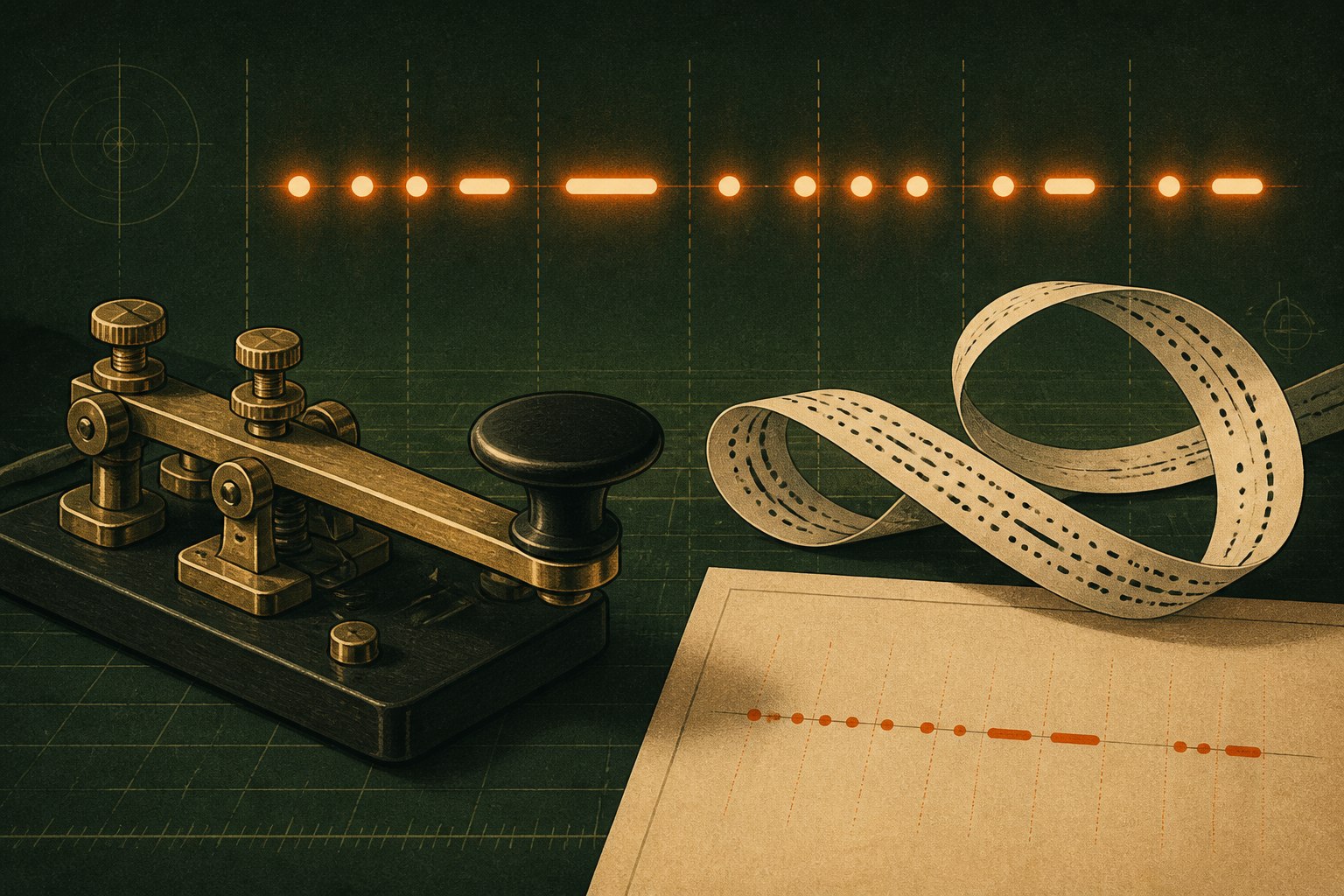
Morse code is not only a sequence of dots and dashes. The silence between signals carries just as much structure as the sound.
One unit sets the whole rhythm
Choose any dot length—60 milliseconds, 100 milliseconds, or another value—and treat it as one unit. A dash lasts three units. The pause between parts of the same character lasts one unit, the pause between characters lasts three, and the pause between words lasts seven.
Why spacing errors are hard to read
Consider the letters A (.-) and E T (. -). The sound marks are the same. Only the gap tells the listener whether they belong to one character or two. Uneven spacing forces the listener to guess where one pattern ends and the next begins.
This is also why making every part of a beginner message uniformly slow is not ideal. Clear character rhythms should remain intact. Extra room can be placed between characters and words, then reduced as recognition improves.
WPM and character speed
Words per minute describes the overall sending rate. In learning systems such as Farnsworth spacing, characters are sent at a faster, natural character speed while the gaps are lengthened. You hear the correct shape of each letter without the full message arriving too quickly.
A quick timing check
- Tap four or five dots at a steady beat.
- Make each dash exactly as long as three dots.
- Leave one silent dot between signals inside a character.
- Leave three silent dots before the next character and seven before the next word.
The ratios—not a particular tone frequency—make the message readable. The International Telecommunication Union publishes these timing relationships in Recommendation M.1677.